
As AI Analyzes the World, Sustainability Requires Experiencing it: An Interview with Franklin Carrero-Martínez

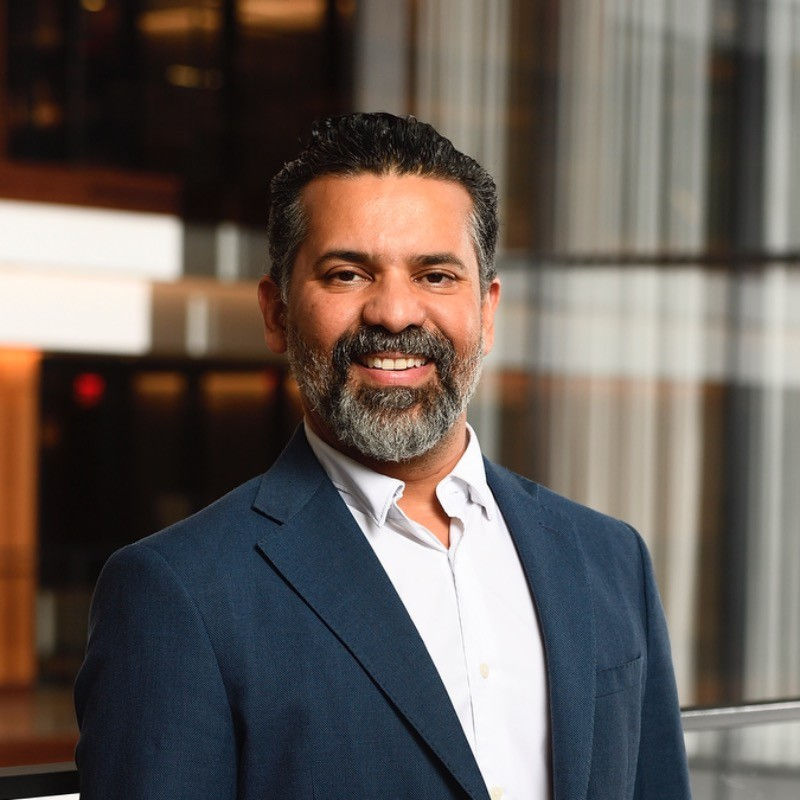
Background and Career Journey
Cristy: Franklin, could you state your official title and your role at NASEM?
Franklin: I am Senior Director of the Science and Technology for Sustainability program at the National Academies of Sciences, Engineering, and Medicine. I have been at the National Academies for almost eight years.
Cristy: Where were you prior to joining NASEM?
Franklin: Before joining the National Academies, I served as Deputy Science and Technology Adviser to the Secretary of State. Prior to that, I worked in the Office of International Science and Engineering at the National Science Foundation. I also served as a science attaché at the U.S. Embassy in Mexico City in 2012, and before my time in government, I was a professor at the University of Puerto Rico for about ten years.
Reframing Sustainability (Our Common Journey)
Cristy: The session you're leading at the NSS conference is titled “Reframing Sustainability for a Resource-Constrained World.” Our Common Journey set the sustainability agenda back in 1999. What is the single biggest assumption in that framework that no longer holds up today, and what is replacing it?
Franklin: The short answer is that we are actively trying to figure that out, and I want to be cautious about assuming that the original framework needs to be replaced. Many of the central insights of Our Common Journey remain remarkably durable. It treated sustainability as a transition rather than a destination, emphasized place, connected human and natural systems, and called for stronger links between knowledge and action. However, that knowledge-to-action transition has not been evenly implemented.
One question that deserves renewed attention is that last one: how do we move more effectively from knowledge to action? We now have nearly three additional decades of science, technology, data, institutional experience, and sustainability practice. Yet communities facing similar transitions can arrive at very different outcomes. That leads us to a question we are exploring: How do communities build the capability to navigate long-term change?
One emerging way of approaching that question is through place. Water, energy, infrastructure, health, economic development, biodiversity, artificial intelligence, and other issues do not occur independently in people’s lives. They interact in particular places.
We are exploring place as a unit of integration and community as a unit of action, while recognizing that decisions and consequences operate across interwoven scales and timescales.
You have all of those layers that somehow interact with one another. And there lies a complexity that we also want to untangle and explore in this revisiting the common journey. This is still exploratory. We are not announcing a replacement for Our Common Journey, nor have we predetermined that the outcome should be another report. The conference is part of the listening and testing process. We want conference participants to challenge the framing, identify what we are missing, and help us determine what would actually be useful.
Cristy: That perspective on multi-scale interdependencies is crucial. Many professional societies tend to narrow their focus to single niches.
Franklin: Yes, sustainability is a systems field, but systems are experienced in places. If we focus too narrowly, we can miss important interactions among ecological, technological, economic, institutional, and social systems. Examining how decisions and consequences move across local, regional, national, and global scales adds an essential dimension.
Sustainability is a systems field, but systems are experienced in places.
Resource Optimization, Scale, and Unmeasurable Metrics
Cristy: You point to "resource optimization" as a practical framework for decision-making. What does that look like in practice, and how does scale affect how we measure success?
Franklin: One clarification is that, as this work has evolved, I would no longer describe resource optimization as the organizing framework. Resource optimization may be relevant to particular decisions, but the broader question is how communities make informed decisions about the futures they seek to sustain under real ecological, technological, economic, and institutional constraints.
Scale remains critical because the answer can look very different depending on where we observe the system. National economic indicators may be strong while a specific community experience housing stress, infrastructure deficits, environmental burdens, or declining opportunity. Both observations can be accurate. The same applies to water: the relevant scale might be a household, municipality, watershed, river basin, state, or region depending on the decision being made.
One question we are exploring is therefore not simply, “Are we making progress?” but “At what scale, over what timescale, according to what evidence, and for whom?” That is one reason place is useful as an organizing principle. It forces us to examine how different systems and scales interact rather than assuming that an aggregate indicator tells us everything we need to know.
We need to be explicit and transparent about which scale we are evaluating so we can identify where systems are actually breaking down.
Cristy: A lot of critical sustainability factors—equity, resilience, trust—don't have clean quantitative metrics. Does resource optimization risk quietly favoring only what is easily measurable?
Franklin: We [scientists] don't know everything, so having community input becomes important because you may be seeing something at your local community. You might have thought about this. You might have experienced this. You might have had a conversation with someone that thinks we need to know this, we need to identify this variable, or I've been doing this and I've been measuring and I have some way, so maybe we can incorporate it. Scientific and technical measures can tell us a great deal, but they do not capture every condition, value, experience, or tradeoff that matters in a particular place.
At the same time, our measurement capabilities have changed dramatically since 1999. Sensors, new data systems, and artificial intelligence may help communities see interacting systems more clearly, whether we are talking about water, energy, transportation, health, or infrastructure.
The opportunity is not to privilege what is easiest to quantify. It is to combine better measurement with local knowledge and deliberation so that evidence supports better decisions rather than defining the decisions for people.
AI, Digital Transformation, and the Limits of Technology
Cristy: Where do you see AI genuinely changing what's possible for sustainability decision-making, and where is it mostly hype?
Franklin: In my mind and experience, AI will become an important tool for sustainability research and decision support. It can help analyze data, identify patterns, model systems, develop scenarios, and make knowledge more accessible. But I think its rapid development makes direct experience of place even more important. A lot of things are accessible on the internet today yet, people pay for ‘experiences’.
AI can describe water scarcity in Arizona or flooding in a coastal community. It cannot substitute for being there, talking with people, understanding institutions and infrastructure, observing the landscape, or experiencing how those conditions shape daily life. Sustainability is fundamentally about interactions among human and natural systems in particular places.
That has implications for sustainability education. Programs that thrive in an AI-rich world may be those that combine powerful digital tools with field-based learning, community engagement, and direct experience. We should use AI for what it does well while becoming more intentional about preserving the forms of learning that require human presence, relationships, judgment, and experience.
It speaks to that fundamental human desire to experience things firsthand. I don't just want to be told about the place, I want to be there. I want to taste the food, smell the flowers, and talk to the people who live there. Sustainability is fundamentally about place and the interaction with those complex systems. If you aren't physically present to understand local equity, weather patterns, and biodiversity, you'll may be missing the full picture.
At the end of the day, we are social beings who need that hands-on, real-world experience. AI can help us analyze data, recognize patterns, model systems, and access knowledge in extraordinary ways. But it cannot substitute for being present in a community and experiencing how those systems interact. This, I think, has substantial implications for academia and professional societies.
The sustainability programs and professional societies that thrive in the future will be those that become good at combining what AI can do with what it cannot provide.
Cristy: What AI cannot do for us is protect the human, social, interactive, experiential, and sensory aspects of learning.
Franklin: Exactly! That framing is right, and it focuses on the human element. There is also an institutional piece that supports those individuals—the university programs and sustainability initiatives that enable people to go to these places, explore, and immerse themselves.
Cristy: Right. So it's not just about the individual; we don't stop at protecting the individual human. We have a responsibility to ensure that institutions and structures also protect the pathways to those lived experiences.
Franklin: Exactly, and that also illustrates the importance of interwoven scales. An individual student operates within a program, a university, a community, and broader educational and professional systems. Decisions made at each of those levels shape what becomes possible at the others.
Credibility, Trust, and Science Communication
Cristy: The conference theme emphasizes credibility and trusted evidence. In an environment of contested information and geopolitical instability, how should institutions rebuild trust in scientific evidence?
Franklin: I think we need to distinguish trust in science from trust in the institutions that produce, interpret, and communicate scientific knowledge. Those are related, but they are not the same thing.
People continue to rely on science and technology constantly, often without thinking about it. At the same time, many institutions that produce or communicate knowledge face declining confidence. Understanding that distinction matters because the solutions are different.
Science also needs to communicate uncertainty better. When evidence changes because we have better data, better instruments, or a better explanation, that is not evidence that science failed. It is how science works. We have not always communicated that process well.
I also think science communication itself needs to become more context-sensitive. Communicating uncertainty about a distant astronomical observation is different from communicating uncertainty about an aquifer that supplies a community’s water. The science may be rigorous in both cases, but the consequences, audiences, values, and decisions involved are different.
We need communicators who can work across those contexts and help translate technical evidence without stripping away uncertainty or local meaning.
That is also why collaboration with artists, designers, communicators, and other creative professionals can be so valuable. Scientists are asked to do an extraordinary number of things—research, teaching, mentoring, grant writing, service, and increasingly public communication.
We should not assume that every scientist must also be an expert communicator. Stronger partnerships can help scientific institutions communicate more clearly, honestly, and effectively.
Closing Thoughts
Cristy: Franklin, we are well past time; this has been so enjoyable and so fun. I'm going to stop here unless there was something we I missed?
Franklin: People will certainly figure out how to incorporate AI, and it will become an essential tool. But for NSS and sustainability programs to thrive, they must retain that experiential component. That place-based experience is what makes sustainability unique compared to other disciplines. Students and practitioners need opportunities to see how ecological systems, infrastructure, institutions, economies, technologies, and communities interact in real places. And those places are embedded within larger systems. A local water decision may depend on a regional watershed, interstate governance, national policy, global markets, or climatic phenomena originating thousands of miles away. That is why we are increasingly interested in place, interwoven scales, and learning over time. The challenge is to connect those dimensions in ways that help communities make better decisions about the futures they seek to sustain.
Cristy: That’s right. Even if you're an ecologist studying systems without direct human involvement, the resource-based element of sustainability still necessitates place. I like that: place-based learning is necessary.
Franklin: Exactly. Place gives us a way to see how those systems come together without pretending that the relevant boundaries are always local. The place might be a neighborhood, a city, a watershed, a river basin, or another geography defined by the problem itself. What matters is understanding both what is happening there and how that place is connected to broader scales.
The NSS Annual Conference
Join hundreds of cross-sectoral sustainability professionals as they share their work that champions evidence-based research, innovative and accessible solutions, and the persistence and preparation essential to building a hopeful and resilient future.
Inspiring plenaries, symposia, roundtables, posters, workshops, professional development courses, fun leisure activities, and networking opportunities await.
The conference will be hosted by Colorado State University's School of Sustainable Futures and the CSU Climate Hub at Spur.


